
Mobile Menu

  • Destinations
    • Canada
      • British Columbia
        • Vancouver Island, B.C.
        • Okanagan
        • Lower Mainland, B.C.
        • Northern B.C.
        • Interior B.C.
        • Kootenays/Rockies
      • Alberta
      • Yukon
      • Northwest Territories
    • U.S.A.
      • Alaska
      • Washington
      • Oregon
      • California
    • West Coast Galleries
  • Experiences
    • West Coast Galleries
      • Nature Photography
      • Wildlife Photography
      • Cityscapes
    • Things To Do
    • Staycation Secrets
      • Canada
      • U.S.A.
    • Adventure
      • Adrenaline
      • Beaches
      • Biking
      • Camping
      • Fishing
      • Hiking
      • Hunting and Fishing
      • Rafting
      • Skiing
    • Sip & Savour
    • Family Activities
    • Indigenous Tourism
    • Accessible Travel
    • Travel Tips & Advisories
  • Newsletter Sign-up
  • Contests
  • About
    • The Armchair Traveller Newsletter
    • Explore our travel guides
    • Impressive West Coast
    • West Coast Partners
    • West Coast Traveller Directory
    • Join Our Team
    • Contact Us
    • Terms of Service
    • Explore West Coast Traveller on TikTok
  • Search
  • Facebook
  • Instagram
  • TikTok Icon
  • Twitter
  • YouTube
  • Flickr Icon
  • Menu
  • Skip to left header navigation
  • Skip to right header navigation
  • Skip to primary navigation
  • Skip to secondary navigation
  • Skip to main content
  • Skip to primary sidebar
  • Skip to footer

Before Header

  • Facebook
  • Instagram
  • TikTok Icon
  • Twitter
  • YouTube
  • Flickr Icon

West Coast Traveller

  • Destinations
    • Canada
      • British Columbia
        • Vancouver Island, B.C.
        • Okanagan
        • Lower Mainland, B.C.
        • Northern B.C.
        • Interior B.C.
        • Kootenays/Rockies
      • Alberta
      • Yukon
      • Northwest Territories
    • U.S.A.
      • Alaska
      • Washington
      • Oregon
      • California
    • West Coast Galleries
  • Experiences
    • West Coast Galleries
      • Nature Photography
      • Wildlife Photography
      • Cityscapes
    • Things To Do
    • Staycation Secrets
      • Canada
      • U.S.A.
    • Adventure
      • Adrenaline
      • Beaches
      • Biking
      • Camping
      • Fishing
      • Hiking
      • Hunting and Fishing
      • Rafting
      • Skiing
    • Sip & Savour
    • Family Activities
    • Indigenous Tourism
    • Accessible Travel
    • Travel Tips & Advisories
  • Newsletter Sign-up
  • Contests
  • About
    • The Armchair Traveller Newsletter
    • Explore our travel guides
    • Impressive West Coast
    • West Coast Partners
    • West Coast Traveller Directory
    • Join Our Team
    • Contact Us
    • Terms of Service
    • Explore West Coast Traveller on TikTok
  • Search
You are here: Home / Travel / How Campbell River became the fishing capital of the world

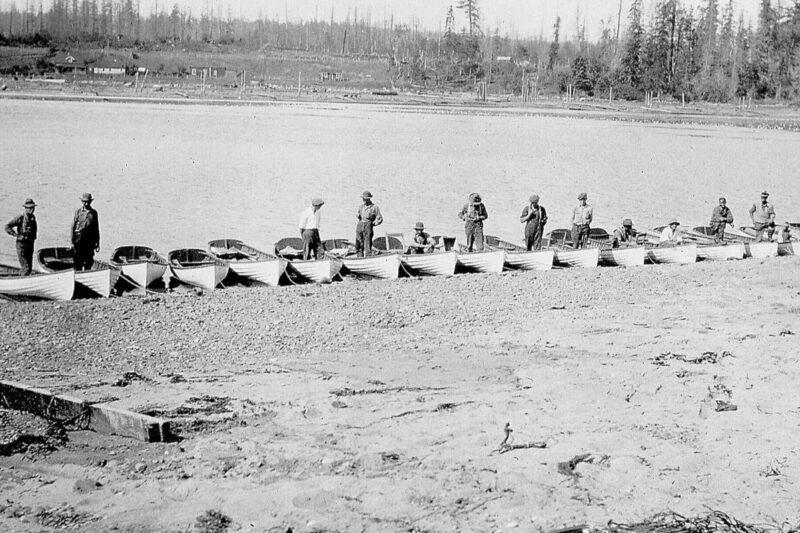
The historic photograph of fishing guides and the wooden Painter boats lined up at the Tyee Spit (Catalogue # 11080). The Tyee Club recently attempted to recreate this photo at their AGM by calling current guides and their boats to line up on the banks of the Tyee Spit.

Museum at Campbell River photo

How Campbell River became the fishing capital of the world

September 10, 2024 //  by Black Press Media Staff

Share this:

Today, the tourism industry is firmly established as a cornerstone of the British Columbia economy.

In 2022, the province boasted 16,910 tourism businesses, employing over 154,000 individuals and generating $18.5 billion in revenue, according to Destination BC. It contributes more to the province’s GDP than mining, agriculture or forestry.

One of the province’s first tourism hotspots was Campbell River — a relatively small coastal community that thrust itself into global prominence by earning the title of “Salmon Capital of the World.”

The roots of tourism in Campbell River can be traced back to the 1880s, when nature-oriented European sportsmen sought adventure. At that time, Comox was establishing itself as a premier sporting destination, offering luxury accommodations and attracting a wealthy clientele, including naval officers, dignitaries and influential businessmen.

These affluent anglers soon discovered the abundant fishing opportunities a little further north. However, travelling to Campbell River posed significant challenges due to the absence of steamship services and docks at the mouth of the river. It was mostly wealthy men with access to private boats that could make the trip.

A pivotal moment in Campbell River’s fishing history occurred in 1896 when Sir Richard Musgrave recorded an impressive catch of a 70 lb Chinook salmon at the mouth of the Campbell River. He published his account in the prominent British sporting magazine, The Field, recounting “some extraordinary fishing which my friend, Mr. H.W. Gordon, of the Royal Engineers, and myself, enjoyed lately on a river in British Columbia.”

They arrived via a steamer loaned by Musgrave’s brother-in-law, a member of the Dunsmuir family, to the Liǧʷiɫdax̌ʷ village at C̓akʷalutən (Cape Mudge). Musgrave also noted hiring a local Indigenous guide, Tom, whose full name unfortunately remains unrecorded. This article drew considerable attention to Campbell River’s fishing potential among the British Commonwealth’s affluent circles.

The burgeoning sport fishing scene gained further momentum from reports in The Field of catches like those by Lindsay Dickson, who recounted staying for 21 days in August 1903, camping along the river, and capturing a staggering 92 salmon, weighing a total of 3,665 pounds — an amount that seems unimaginable by today’s standards.

By the early 1900s, Campbell River had firmly established itself as a destination for catching very large Chinook salmon. A new hotel opened in 1904 offered these fishing enthusiasts far more comfortable accommodation than staying in a tent on the beach. Guests of the Willow Hotel could also hire a boat and guide to get them to the fishing waters.

At this time, visiting anglers relied heavily on Liǧʷiɫdax̌ʷ fishing guides, who possessed extensive knowledge and expertise in these waters, crucial for locating fish and maneuvering boats through challenging tides and currents found in the river and surrounding waters. The involvement of skilled Liǧʷiɫdax̌ʷ guides helped facilitate the rapid development of a sport fishery.

Gradually, the number of Indigenous guides decreased during the late 1900s, likely because they could earn better pay by selling salmon they caught to the nearby cannery on Quadra Island, which operated from 1904 to 1941. Some continued to guide though, as news articles mentioned Dan Assu and Johnny Quocksister among the guides for the King of Siam’s entourage in 1931.

In 1924, the idea of creating a club to promote and award sportsmanship in Chinook fishing took shape in the minds of Dr. J.A. Wilborn of California, Melville Haigh of the Willows Hotel, and Alfred Newton Wolverton of Vancouver.

The Tyee Club of British Columbia was established with stringent rules for fishing, ensuring the participating members gave the fish a fair fight. Only by catching a Tyee, a Chinook salmon weighing 30 pounds or more, could someone become a member of the Tyee Club. In the following decades, the exclusivity of the club attracted wealthy tourists from around the globe, further solidifying Campbell River’s status as the fishing capital of the world.

Notable figures like Hollywood stars Bob Hope and Bing Crosby attempted to join the ranks of Tyee Club members but failed, while local activist and expert fly fisher Roderick Haig-Brown successfully secured his spot.

An essential aspect of Campbell River’s enduring reputation lies in the role played by local guides, many of whom were descendants of settlers and Indigenous families. Hiring a guide was not merely about securing a boat or fishing gear; it was about gaining access to a wealth of knowledge. Guides were skilled in the local waters, adept at luring fish, and proficient in coaching visitors through the art of angling.

From the 1960s to the 1980s, many of the early guides retired and transitioned to guiding friends and family rather than paying clients. These friends and family members then became guides and the popularity of Tyee fishing broadened. What began as a sport for the elite transformed into a recreational activity for locals and visitors alike.

As the decades progressed, the nature of tourism in Campbell River began to evolve. By the late 20th century, even as fishing fortunes fluctuated due to declining salmon stocks, tourism in the region did not wane. A new breed of ecotourists became attracted to the area for kayaking, camping and whale watching.

Today, the legacy of its early fishing traditions lives on, augmented by a new generation of ecotourists and adventure seekers. As Campbell River continues to embrace its diverse tourism offerings, it stands as a testament to the spirit connection to nature that lives in British Columbia.

A Look Back into the History of the Campbell River Area is a presentation of the Museum at Campbell River and the Campbell River Mirror.

* * * * *

Plan your adventures throughout the West Coast at westcoasttraveller.com and follow us on Facebook and Instagram @thewestcoasttraveller. And for the top West Coast Travel stories of the week delivered right to your inbox, sign up for our weekly Armchair Traveller newsletter!
Share this:

Category: TravelTag: British Columbia Destinations, Campbell River, Canada, Fishing, History, Things to Do in Vancouver Island

Related Posts

You may be interested in these posts from the same category.

A new lifeline for anyone travelling through British Columbia

On Vancouver Island’s logging roads – the ones stretching into Nahmint Lake, over into Nitinaht…

A new lifeline for anyone travelling through British ColumbiaRead More

WSDOT: More important than ever to plan ahead for holiday traveling

EVERETT — Holiday travelers should leave early and plan their routes ahead of time to…

WSDOT: More important than ever to plan ahead for holiday travelingRead More

Endangered wild Vancouver Island marmot population reaches record high

The wild population of Vancouver Island marmots has reached a new record high with 427…

Endangered wild Vancouver Island marmot population reaches record highRead More

Victoria’s Craigdarroch Castle celebrates the season with holiday tours

Victoria’s Craigdarroch Castle is preparing for its holiday season and everyone is invited! Running from…

Victoria’s Craigdarroch Castle celebrates the season with holiday toursRead More

Slopes set to open for the winter at Big White

The day is finally here for mountain goers and snow sport aficionados as the slopes…

Slopes set to open for the winter at Big WhiteRead More

8 ways to get festive in Surrey

While snow may be in short supply during a typical southwest B.C. winter, Christmas spirit…

8 ways to get festive in SurreyRead More

Vernon Winter Carnival 2026 launches ticket sales Dec. 5

One of the Okanagan’s favourite winter events returns for its 66th year this February, with…

Vernon Winter Carnival 2026 launches ticket sales Dec. 5Read More

Vancouver Christmas Market celebrates magical 15th anniversary season

Vancouver’s original German Christmas Village, the Vancouver Christmas Market, celebrates its 15th anniversary season, returning…

Vancouver Christmas Market celebrates magical 15th anniversary seasonRead More

Tulalip unveils the largest holiday lights display in Washington

Carolers sang Here Comes Santa Claus at the Tulalip Resort Casino on this month, but…

Tulalip unveils the largest holiday lights display in WashingtonRead More

Previous Post: « Where nature and wellness meet on Vancouver Island’s rugged West Coast
Next Post: Rossland, B.C. hosts weekend Arts and Culture Festival »

Primary Sidebar

Things To Do

A new lifeline for anyone travelling through British Columbia

January 22, 2026

WSDOT: More important than ever to plan ahead for holiday traveling

December 23, 2025

Endangered wild Vancouver Island marmot population reaches record high

December 3, 2025

Victoria’s Craigdarroch Castle celebrates the season with holiday tours

December 3, 2025

Recent Posts

A new lifeline for anyone travelling through British Columbia

January 22, 2026

WSDOT: More important than ever to plan ahead for holiday traveling

December 23, 2025

Endangered wild Vancouver Island marmot population reaches record high

December 3, 2025

Victoria’s Craigdarroch Castle celebrates the season with holiday tours

December 3, 2025

Footer

The West Coast Traveller has an immense social media footprint, with eight social media sites and and 125,000+ social followers.

Join us on social media and Join Our Community by sharing your stuff!

Get Inspired

News Media Groups

Black Press Media
Sound Publishing
Oahu Media Group
Alaska
Boulevard Magazines
Used.ca

Let’s Get Social

West Coast Traveller
I Love British Columbia
I Love Alberta
I Love Yukon
I Love Northwest Territories
I Love Washington
I Love California
I Love Oregon
I Love Alaska

Visit Our Companion Sites

I Love Saskatchewan
I Love Manitoba
I Love Nunavut
I Love Ontario
I Love Quebec
I Love Newfoundland and Labrador
I Love Nova Scotia
I Love New Brunswick
I Love Prince Edward Island

Site Footer

  • Facebook
  • Flickr
  • Instagram
  • TikTok Icon
  • Twitter
  • YouTube

Copyright © 2026 West Coast Traveller and · All Rights Reserved